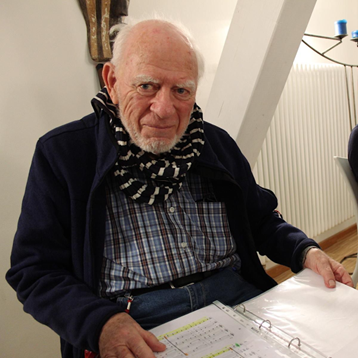
It is with deep sadness that we bid farewell to Jens Blauert, who passed away in Berlin in mid-March at the age of 87, surrounded by his family, following a brief but serious illness. For more than half a century, he shaped the fields of acoustics in Germany, Europe, and internationally. His scientific work made a significant contribution to our understanding of psychoacoustics and binaural hearing.
Jens Blauert was born in Hamburg in 1938. After attending school in Dresden and Hamburg, he studied Electrical Engineering at RWTH Aachen University, where he earned his diploma in 1964. During his studies, he specialized in communications engineering – what we would call information technology today – and his thesis focused on a device for error detection in data transmission. It was therefore only natural that he subsequently joined the Institute for Communications Engineering at RWTH Aachen University as a research assistant under Volker Aschoff; an institute that is currently headed by a student of Jens Blauert, Alexander Raake. During his time as a research assistant there, Jens Blauert devoted himself entirely to binaural hearing and received his doctorate with honors in 1969 with a dissertation on “Investigations into directional hearing in the median plane with a fixed head.”
Directional hearing also dominated the rest of his time in Aachen, although he also had considerable exposure to technical acoustics there. Unfortunately, RWTH Aachen University was reluctant to approve habilitations at that time. Thus, it was thanks to a fortunate coincidence that he was able to complete his habilitation in 1973 under Lothar Cremer at the TU Berlin in the field of “Psychoacoustics and Electroacoustics.” Just one year later, Jens Blauert received a call to the recently established Faculty of Electrical Engineering at Ruhr University Bochum. A chair in General and Theoretical Electrical Engineering was to be filled there, and ultimately this broad field was divided into two professorships. His chair was therefore initially named “General Electrical Engineering and Electroacoustics” (AEEA), until Jens Blauert discovered that the term “Institute” was not protected in the federal state of North Rhine-Westphalia. Without further ado, he founded the “Institute for Communication Acoustics” (IKA), which still exists today under the same name, and thus shaped the terminology in this field, which is important for both interpersonal communication and human-computer interaction.
The telecommunications perspective is clearly evident right from the start of his seminal work Spatial Hearing – the book he published in 1974 based on his habilitation thesis under Hirzel, and which has since been translated into many languages (as early as 1979 into Russian, 1984 into English, and 1986 into Japanese). The second expanded edition of Spatial Hearing from 1997 is likely to be on the shelves of most acousticians and audiologists. The directional frequency bands, sometimes referred to as Blauert’s bands, which are crucial for directional hearing in the median plane, also stem from his work. Yet Jens Blauert was not only concerned with understanding the mechanisms of human hearing, but above all with making these mechanisms technically usable “for social good.”
Thus, various research groups emerged within his IKA, focusing on virtual acoustic environments, speech recognition and speech synthesis, audiology and measurement technology – that group led by Herbert Hudde as an extraordinary professor – as well as perceptual system quality. The latter is a field for which Jens Blauert laid the groundwork as early as 1986 in a plenary lecture in Cambridge, MA, and which is now known as sound engineering. Ute Jekosch and later Ercan Altinsoy then pursued this interdisciplinary topic at TU Dresden. This breadth of research is also the result of a wise academic leadership culture: Jens Blauert excelled at motivating young researchers to pursue their own research topics and ideas. Anyone who felt at home under his “communication acoustics” banner and was successful in scientific projects received his support – even if the topics did not fall directly within the scope of Jens Blauert’s own research.
The fruits of his academic leadership are impressive: Jens Blauert supervised 52 dissertations, and many of his students now serve as professors at universities in Germany, the U.S., or elsewhere. A special volume of the Bochum “Blaue Hefte” from 2004 summarizes the dissertations he supervised. Practical skills could also be learned at the IKA, as the institute was recognized as a testing facility for sound insulation measurements. Inspired by this, some of his graduates later became independent entrepreneurs. As an acoustic consultant, Jens Blauert influenced the room acoustics of large auditoriums and concert halls, schools, and hospitals. He also provided advice on problematic cases of neighborhood noise, the planning of sound barriers, and machine noise.
And, of course, this work had a major impact on the German, European, and international scientific community. Jens Blauert was one of the founding fathers of the German Acoustical Society (DEGA), which he also led as president from 2001 to 2004. Under its auspices, he organized the German Annual Conference on Acoustics (DAGA) three times in Bochum, in 2002 together with his student Ute Jekosch. As a child of World War II, European unity was very close to his heart, making him a driving force behind the founding of the European Acoustics Association (EAA); he served on the EAA board for many years and served as its president from 1996 to 1998. He also had an excellent network in Poland, France, Denmark, and Greece – a lucky situation for his doctoral students, for whom this opened doors internationally. He was a Fellow and recipient of the Helmholtz-Rayleigh Interdisciplinary Silver Medal (1999) from the Acoustical Society of America (ASA), recipient of the Helmholtz Medal (2001) from the DEGA, Scientific Medalist (2003) of the International Speech Communication Association (ISCA), a Fellow of the International Commission for Acoustics (ICA), a Fellow and recipient of the Gold Medal (2008) from the Audio Engineering Society (AES), an honorary member of the German Society for Audiology (DGA) since 2004, and – last but not least – recipient of the EAA’s highest honor, the Award for Lifetime Achievements in Acoustics (2011).
Even after his retirement in 2003, Jens Blauert remained intellectually curious: beginning in 2005, he served as an adjunct professor at Rensselaer Polytechnic Institute in Troy (NY, USA), where he published the book Communication Acoustics (2005, Springer). He subsequently co-authored the book Acoustics for Engineers (2008, Springer) with his student Ning Xiang, edited the book The Technology of Binaural Listening (2013, Springer), and, together with his student Jonas Braasch, co-edited the book The Technology of Binaural Understanding (2020, Springer). The latter title points to a direction that increasingly interested Jens Blauert in his later years: the understanding of “meaning” for spatial and related aspects of hearing, including cross-modal inferences. In doing so, he incorporated cognitive science, as the technical application of these specific scientific findings requires knowledge of human cognitive abilities, including substantial innate knowledge, as well as the ability to integrate information across different sensory modalities. To systematically investigate binaural computer programs under real-time conditions, Jens Blauert initiated the consortium project TWO!EARS (2013–2017) at the age of 75, which was funded by the European Commission. The focus was on incorporating top-down feedback mechanisms as well as the use of audiovisual virtual reality and robotic test beds to evaluate the algorithms. Parallel to these research approaches, the group Aural Assessment By means of Binaural Algorithms (AABBA), which he also founded, has been dedicated to this topic since 2008. AABBA focuses on the development and application of computer models of spatial hearing and makes these models available in an Auditory Modeling Toolbox.
Jens Blauert leaves a huge gap in our community. We have lost an excellent mentor, an inspiring scientist, a dedicated musician, and, for many of us, a sincere friend.
Berlin, 26 March 2026
Sebastian Möller, Ute Jekosch, Alexander Raake