Forum Acusticum 2026 – Highlights from Graz
Forum Acusticum 2026 took place in Graz, Austria, from 8 to 12 September, bringing together the acoustics community for five days of scientific exchange, collaboration, discussion and networking. With participants from 50 countries and a broad programme spanning 24 scientific areas, the congress provided a platform for researchers, professionals, students and organisations from across the acoustics community to meet and share their work.
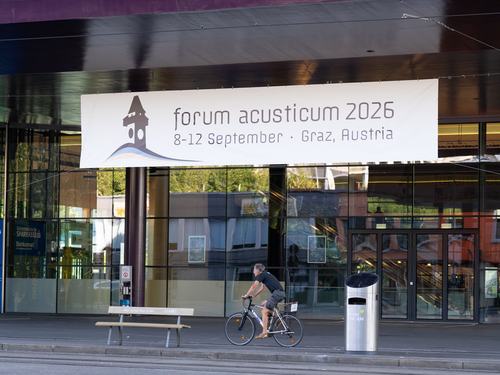
Photo: © Raphael Köstl
Key Figures and Scientific Programme
The 2026 edition featured:
- 24 scientific areas
- 240 scientific sessions, including 177 oral and 63 poster sessions
- 846 contributions
- 730 oral presentations
- 112 poster presentations
- 4 plenary lectures
- 211 papers submitted for full-paper review
The four plenary lectures covered a broad range of topics, from auditory modelling and virtual reality in hearing research to sound absorption and the role of architectural acoustics in the design process.
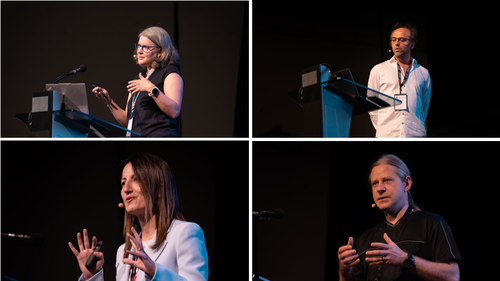
Photos: © Raphael Köstl
A total of 1.150 registrations were recorded from 50 countries. The registered participants included 336 EAA members, 410 non-EAA members, 356 students and 10 retired professionals. A further 36 participants registered exclusively for the EAA Summer School.
EAA Summer School
The EAA Summer School was held in conjunction with Forum Acusticum 2026, providing an opportunity for young researchers and students to engage in focused teaching and discussion around a range of acoustics topics.
A total of 132 participants took part in the Summer School: 36 attended the Summer School only, while 100 also participated in Forum Acusticum 2026. The programme covered nine topics, with between 10 and 21 participants per topic.
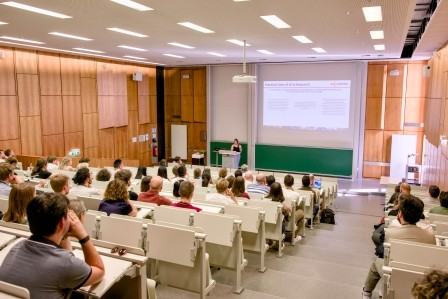
Photo: © Felix Holzmueller
EAA Award for Contributions to the Promotion of Acoustics in Europe
The EAA Award for Contributions to the Promotion of Acoustics in Europe was presented to Eng. Dr. Jorge Patrício, Research Coordinator at the National Laboratory for Civil Engineering (LNEC), Portugal.
The award was presented during the Forum Acusticum 2026 Opening Ceremony.
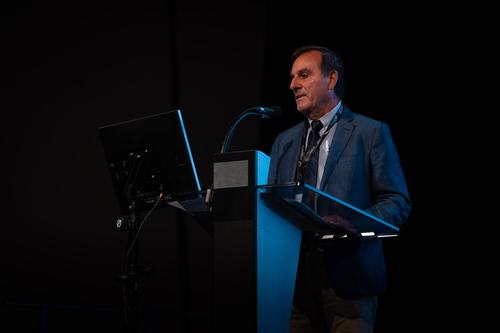
Photo: © Raphael Köstl
Best Student Paper Awards
To promote the submission of high-quality work by young researchers, the EAA awarded six Best Student Paper Prizes at Forum Acusticum 2026. The prizes, funded by the HEAD-Genuit Foundation, were worth €1.000 each. A total of 40 applications were received.
The six recipients were:
- Josephine Pockelé (Delft University of Technology, The Netherlands) – Quantification of Modelled Wind Turbine Noise Ground Reflections
- Victor Zhelezhnov (University of Edinburgh, UK) – Explicit and Stable Pseudospectral Time-Domain Method for the Föppl–von Kármán Equations
- Thomas Deppisch (Chalmers University of Technology, Sweden) – Direction-Preserving MIMO Speech Enhancement Using a Neural Covariance Estimator
- Likun Luo (Technical University of Vienna, Austria) – A Robust Adaptive Wavenumber Sampling Approach for Efficient 2.5D Acoustic Simulations
- Jonas M. Schmid (Technical University of Munich, Germany) – In Situ Characterization of Non-Planar Sound Absorbers Using Physics-Informed Neural Operators
- Maryam Bajool (Technical University of Munich, Germany) – Spatial Auditory Attention Decoding Using Gammatone-Based Representations Under Clean and Binaural Conditions
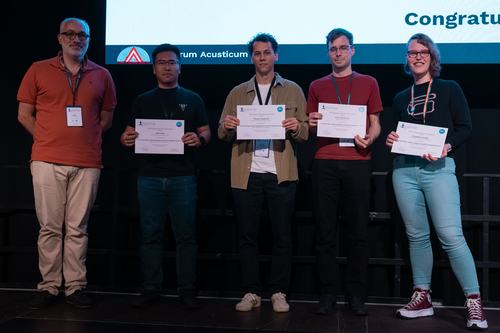
Photo: © Raphael Köstl
EAA Travel Grants
To support the participation of early-career researchers, the EAA awarded 15 travel grants for Forum Acusticum 2026. Each grant included €500 in financial support and free registration for the congress.
The recipients were:
- Tianjing Feng (UK)
- Max Væhrens (Denmark)
- Gamze Cengiz (Türkiye)
- Sofie Becuwe (Belgium)
- Augusto Fantinelli (Spain)
- Ekaterina Kostyleva (Russia)
- Samuel Dickinson (UK)
- Pasupathan Chithra Barani (The Netherlands)
- Emilia Żak-Stefanowska (Poland)
- Francesco Veronesi (UK)
- Robin Mafféis (France)
- Ching Jo Hsu (Finland)
- Jesús Vaquerizo-Serrano (Spain)
- Saba Dalirnaghadeh (Türkiye)
- Conor Byrne (Ireland)
Exhibition: Where Science Meets Application
The Forum Acusticum 2026 exhibition brought together 27 exhibiting organisations across five exhibition regions, creating a shared space for interaction between the scientific and industrial sides of the acoustics community.
The exhibition also included six sponsor partnerships and a shared exhibition hall designed around five areas, providing opportunities for participants to discover products, technologies and services and exchange ideas with industry representatives.
EAA Women+ Initiative
Forum Acusticum 2026 marked the kick-off of the EAA Women+ initiative, with a dedicated meeting introducing the initiative to the acoustics community and providing an opportunity to discuss ideas and possible activities for the future.
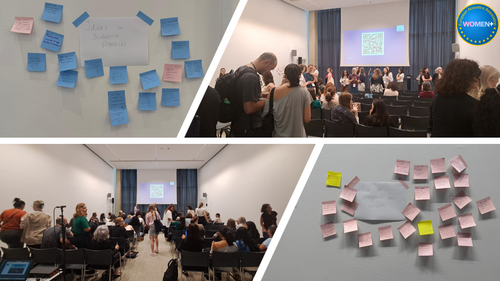
The congress also featured Women+ Wednesday, which brought together 120 participants for an evening of discussion and exchange around inclusion and equal opportunities in acoustics.
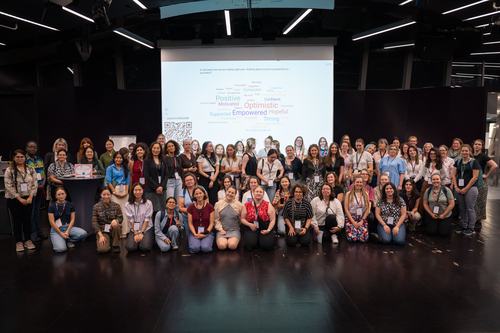
Photo: © Raphael Köstl
A Programme Beyond the Scientific Sessions
Alongside the scientific programme, Forum Acusticum 2026 offered a varied social programme, including dinners, a concert, a jam session and technical tours, providing additional opportunities for participants to meet and exchange in a more informal setting.
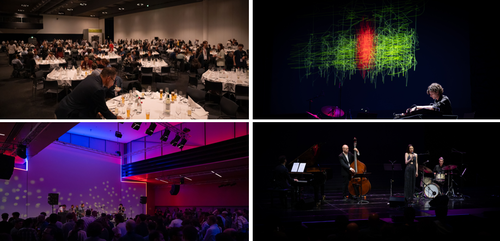
Photos: © Raphael Köstl
Thank You to the Student Volunteers
A successful congress also depends on the people working behind the scenes. Forum Acusticum 2026 was supported by 75 student volunteers, who contributed to the organisation and smooth running of the event.
The EAA would like to thank all 75 student volunteers for their valuable contribution to Forum Acusticum 2026.
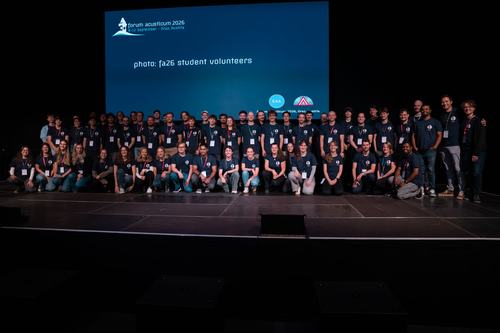
Photo: © Raphael Köstl
The EAA thanks the Forum Acusticum 2026 organising committee, the local teams, the Young Acousticians Network, the exhibitors, sponsors, speakers, contributors and all participants who helped make the congress possible.

ACOUSTICS '27
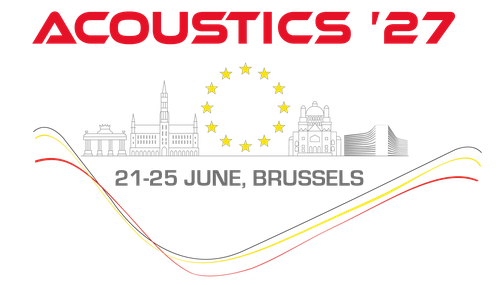
The European Acoustics Association is pleased to announce Acoustics ’27, which will take place from 21 to 25 June 2027 in Brussels, Belgium.
Acoustics ’27 will bring together the 4th Joint Meeting of the Acoustical Society of America (ASA) and the European Acoustics Association (EAA) and will also host the 2027 Congrès Français d’Acoustique (CFA).
The conference is organised by the Belgian Acoustical Association (ABAV) in collaboration with the ASA, EAA and Société Française d’Acoustique (SFA).
Programme at a Glance
The programme at a glance is now available on the conference website, providing an overview of the event programme and its main components.
The congress will also feature five plenary lectures by:
- Deniz Başkent – Communication beyond speech with hearing loss and hearing devices
- Kelly J. Benoit-Bird – Echoes from the Deep
- Karl Janssens – The Evolution of Transfer Path Analysis (TPA) in Automotive Sound Engineering
- Tapio Lokki – Concert hall acoustics beyond ISO 3382-1
- Kathryn Matlack – Manipulating waves with phononic media: opportunities with nonlinearity and flow control
Technical Programme
The technical programme is organised around 18 technical areas, covering a broad range of topics across acoustics.
Technical Areas and Structured Sessions
Information for Authors
Authors can choose between three publication options:
- submit an abstract only;
- submit an abstract and a 4-6 page paper for peer review and publication in the Forum Acusticum 2027 Proceedings; or
- submit an abstract and, after the conference, a paper to POMA (Proceedings of Meetings on Acoustics).
All authors must first submit an abstract through the conference submission system. The abstract submission deadline is 25 January 2027.
Papers for the Forum Acusticum 2027 Proceedings can be submitted between 16 November 2026 and 25 January 2027 and will be evaluated by two independent reviewers. Acceptance for presentation at the conference is based on the abstract and does not depend on the outcome of the full-paper review.
Further information for authors, including the submission process and publication options, is available on the conference website.
Important Information for Authors
Key Dates
- 15 October 2026 – Registration opens
- 16 November 2026 – Abstract and paper submission opens
- 25 January 2027 – Abstract and paper submission deadline
- 15 March 2027 – Early-bird registration deadline
- 19 May 2027 – Final programme release
We look forward to welcoming the acoustics community to Brussels in June 2027.
Acoustics ’27 conference website.
EAA Endorsed Events
The EAA is proud to endorse a range of outstanding upcoming events in the field of acoustics. These conferences provide excellent opportunities for knowledge exchange, networking, and exploring cutting-edge advancements across diverse acoustical topics.
3rd International Symposium on the Acoustics of Ancient Theatres (SAAT 2026)
The 3rd International Symposium on the Acoustics of Ancient Theatres (SAAT 2026) will take place from 25 to 28 October 2026 at the Polytechnic University of Cartagena, Spain.
Organised by the Spanish Acoustical Society (SEA) and the EAA Technical Committee on Room and Building Acoustics, in collaboration with the Acoustical Society of Italy (AIA) and the Hellenic Institute of Acoustics (HELINA), the symposium will bring together researchers and practitioners working on the acoustics of ancient theatres and other culturally and historically significant sites.
Set in the historic city of Cartagena, the symposium offers participants the opportunity to combine scientific exchange with visits to remarkable archaeological and cultural landmarks, including the city's renowned Roman Theatre.
The scientific programme will include:
- Keynote lectures
- Oral sessions
- Poster sessions
- Technical discussions and workshops
Topics cover a wide range of research areas, including acoustic measurements, simulation and auralization, soundscapes, virtual reconstructions, and the preservation of cultural heritage through acoustics.
Technical Programme
The technical sessions are now available online, allowing participants to explore the scientific programme and plan their attendance in advance.
Keynote Speakers
- John Mourjopoulos – Ancient Theatre Acoustics: Insights for Modern Acoustics and Cultural Heritage
- Angela Bellia – Sonic Heritage and Heritage Acoustics: Towards the Preservation of Ancient Performance Spaces
- Michael Vorländer – Reflection Characteristics in Heritage Spaces – Challenges in Simulation
Registration
Early-bird registration is available until 1 October 2026.
Further information, the technical programme and registration details are available on the official conference website.
ASSA 2026 – Autumn School Series in Acoustics
The 5th edition of the Autumn School Series in Acoustics (ASSA 2026) will take place from 2 to 6 November 2026 at Eindhoven University of Technology (TU/e), The Netherlands.
ASSA is a yearly one-week school at post-graduate PhD level, organised by the TU/e Building Acoustics group. The school covers fundamental and applied topics in acoustics and brings together lecturers from various international research institutes. The 2026 edition will feature two parallel schools:
- Auralization
- Experimental Methods in Acoustics
The programme includes lectures and tutorials throughout the week, with topics ranging from auralization fundamentals, receiver modelling and spatial audio reproduction to measurement methods, measurement uncertainties, structural vibration and active noise control.
ASSA welcomes participants from academia and industry, offering both training and opportunities for networking with fellow researchers and professionals in the field.
Programme available
The full programme for ASSA 2026 is now available online, allowing participants to explore the content of both parallel schools and plan their participation.
ASSA 2026 Programme
Registration
Registration is open until 30 September 2026, subject to availability. The number of participants in each school is limited to 30.
Further information and registration details are available on the official ASSA 2026 website.
ASSA 2026 website
SAPEM 2026 – 8th Symposium on the Acoustics of Poro-Elastic Materials
The 8th Symposium on the Acoustics of Poro-Elastic Materials (SAPEM 2026) will take place from 16 to 20 November 2026 at Université Gustave Eiffel, in Marne-la-Vallée (Greater Paris), France.
Since 2005, SAPEM has been a key international forum bringing together researchers, students and professionals working on acoustic porous and poro-elastic materials, providing a platform to share advances, exchange ideas and discuss future challenges in the field.
Topics include (but are not limited to):
- Sustainable development goals
- Characterization (micro & macro), modelling and computational methods
- Materials with flow
- Structure–property–manufacturing relationships (bio-inspired, architected, sustainable, multi-physics)
- Meta-materials and meta-structures (negative response, couplings, non-reciprocal effects, sorption)
The program will feature keynote lectures, contributed oral presentations, poster sessions, panel discussions, and social events, fostering scientific exchange and community interaction.
Keynote speakers
- Gwennaël Gabard – Aeroacoustics: flow in porous or vice versa
- Olivier Dazel – Numerical techniques for poro-elastic media or multi-layer systems
- Rodolfo Venegas – Thermo-aero-acoustics of poro-elastic media
- Philippe Coussot – NMR relaxometry for characterizing structure, phase changes and water transport in multi-scale biobased porous systems
- Wiebke Drenckhan & Aurélie Hourlier-Fargette – Guiding self-assembly of bubbles to control foam structures
- Sandrine Marceau – Durability of Bio-Based Construction Materials: Key Challenges, Evaluation Methods and Long-Term Performance
- Michael Haberman – State of the art and future of meta-materials
- Claude Boutin – Vibroacoustics of mechanical systems: Homogenisation and experiments
- Franck Sgard – Challenges for hearing protection: comfort, vibro-acoustic models, measurements and innovative materials
- Michel Bornert – Imaging techniques: X-ray for in-situ characterisation
- Raymond Panneton – Methods for characterizing acoustic materials (at macro- and micro- scales)
- Eric Brandao – From standing waves to to complex model-based inference: the evolution of in situ and free-field characterization of porous materials
- Mathieu Gontier – title to be announced
Preliminary programme now available
Further information, including submission guidelines and programme updates, will be made available on the official SAPEM 2026 website.
Urban Sound Symposium 2027
The 5th Urban Sound Symposium (USS 2027) will take place from 7 to 9 April 2027 at Technische Universität Berlin, in Berlin, Germany.
Following the previous editions held in 2019, 2021, 2023 and 2025, the symposium will bring together researchers, practitioners and experts working on the challenges of sound and noise in urban environments. The event addresses topics including urban sound planning and design, sound propagation and control, soundscape analysis, and noise policy, with an interdisciplinary focus bringing together acousticians, architects and planners.
The preliminary programme is now available, featuring confirmed speakers and a range of contributions addressing current developments and challenges in urban sound. Presentation titles and themes remain tentative, with further programme details to be added as they are confirmed.
Preliminary Programme
Workshop: Urban Soundscapes in Practice
As part of the symposium, the workshop Urban Soundscapes in Practice will take place on 7 April 2027. The workshop aims to bridge the gap between research and the practical implementation of soundscape approaches in urban planning, using international case studies and interactive discussions to explore how soundscape thinking can be integrated into planning processes and decision-making.
Workshop information
Registration
Registration for the Urban Sound Symposium will open on 25 October 2026. Further information on registration fees and participation will be announced by the organisers.
Further information about the symposium is available on the official conference website.
Urban Sound Symposium 2027 website
ICTCA 2027 – 17th International Conference on Theoretical and Computational Acoustics
ICTCA 2027 will take place from 30 August to 2 September 2027 in Santiago de Compostela, Spain.
ICTCA 2027 brings together the international community working in theoretical and computational acoustics for four days of science, discussion, and networking, providing a forum to exchange ideas and present the latest advances in the field.
The scientific programme will include:
- Plenary lectures
- Structured sessions and mini-symposia
- Poster sessions
- Social activities, fostering interaction and collaboration
The conference is organised by CITMAga – Galician Centre for Mathematical Research and Technology, and promotes interdisciplinary collaboration across computational acoustics, applied mathematics, computer science, and virtual acoustics. The event is held in cooperation with the Universidade de Santiago de Compostela, the Universidade da Coruña, and the Sociedad Española de Acústica (SEA).
Set in a city known for its rich history, vibrant cultural life, and strong academic environment, ICTCA 2027 offers an inspiring setting for both professional exchange and exploration.
NEW: Special Minisymposia
Proposals for Special Minisymposia are welcome in all areas of theoretical and computational acoustics. Each minisymposium should focus on a coherent research theme and include 20-minute talks with a minimum of three participants. Proposals may be submitted individually or jointly by up to three organisers and should preferably include contributions from researchers from different institutions. Each proposal must include the organisers’ names, affiliations and contact details, the minisymposium title, a short scientific abstract (maximum 500 words), up to five keywords, and a list of potential invited speakers and their affiliations.
Key dates
- Minisymposium Proposals Submission: 30 November 2026
- Paper & Poster Submission: 31 March 2027
- Early registration (reduced fee): before 31 May 2027
Further information will be made available on the official conference website.
Discover the EAA Technical Committees
The EAA Technical Committees (TCs) are the scientific engine of the European Acoustics Association. Each TC brings together researchers, professionals, and students working within a specific field of acoustics, creating active communities where knowledge is shared and new ideas take shape.
The EAA Technical Committees are:
- Computational Acoustics
- Musical Acoustics
- Noise
- Psychological and Physiological Acoustics (PPA)
- Room & Building Acoustics
- Audio Signal Processing
- Ultrasounds
- Acoustic Materials
- Education
- Underwater Acoustics
The TCs play a central role in the scientific life of the EAA.
They organise sessions at EAA conferences, contribute to the EAA Summer Schools, launch studies and initiatives within their domain, prepare strategy documents and state-of-the-art reviews, and propose special issues for Acta Acustica. Many of the EAA’s activities and scientific outputs originate directly from the work of the TCs.
Joining a Technical Committee means becoming part of a collaborative European network. It is an opportunity to exchange ideas, meet colleagues across Europe, contribute expertise, and take an active role in shaping the future of acoustics. TCs are open to motivated members at all career stages, from early-career researchers to established specialists.
Membership is simple: each TC page on the EAA website includes a description, recent activities, and the contact details of the Chairs, who welcome expressions of interest.
Explore all Technical Committees here: https://euracoustics.org/technical-committees/
Find your community!
Acta Acustica: One Year of Diamond Open Access – Impact, Reach and the Way Forward
After one year operating under a Diamond Open Access (DOA) model, Acta Acustica presents a consolidated overview of the results achieved, highlighting the journal’s growing scientific reach, increased visibility, and strengthened commitment to equitable Open Science.
The transition to DOA has enabled Acta Acustica to remove financial barriers for authors and readers alike, while maintaining high editorial standards and reinforcing its role as a truly community-driven journal in acoustics.
Growing institutional support for Diamond Open Access
At the launch of the Diamond Open Access model, four institutions were supporting Acta Acustica. One year later, this number has grown to seven, reflecting increasing confidence in the journal’s Open Access approach and long-term vision.


This growing base of institutional support illustrates a shared commitment to sustaining a high-quality, APC-free scientific journal serving the international acoustics community.
Increased diversity of submissions and authorship
One of the most visible impacts of Diamond Open Access has been the significant increase in geographical diversity among authors.
During its first year in DOA, Acta Acustica attracted submissions from 41 countries, including six countries from the Research4Life programme, representing almost double the diversity observed during the previous three years.
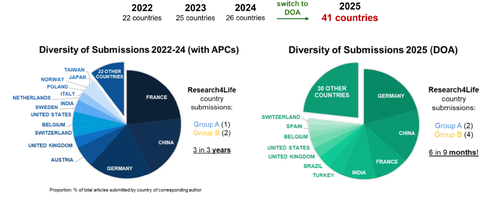
This broader participation confirms the role of Diamond Open Access in enabling researchers from underrepresented regions to contribute more easily to international scientific publishing.
Global reach, visibility and next steps
The distribution of published articles in 2025 reflects a balanced global profile, with strong contributions from Europe, Asia and other regions worldwide. Publication volumes have remained stable throughout the year, confirming the robustness of the journal under the Diamond Open Access model.
Since January 2025, article downloads have increased by 65% compared to 2024, already matching the growth observed between 2023 and 2024. This sustained rise in readership highlights the positive impact of unrestricted access on the visibility and dissemination of acoustics research.
To support this transition, Acta Acustica has improved its communication tools and online presence. The website was restructured to provide clearer information on Diamond Open Access, acknowledge institutional supporters more comprehensively, and present progress in a transparent and accessible way. An infographic leaflet summarising key results was also introduced to support outreach activities.
Further details, figures and updates on Acta Acustica’s Diamond Open Access journey are available on the journal’s website.
Researchers are invited to take advantage of this opportunity to share their work with a growing, engaged audience. Check how to submit your paper to Acta Acustica here.
Discover DAEL – The European Acoustics Association’s Open-Access Portal
The European Acoustics Association offers DAEL – Documenta Acustica Electronica, a central platform to find, share, and preserve acoustics knowledge. Designed for professionals, researchers, and students, DAEL provides open-access resources across all areas of acoustics.
Benefits of registering for DAEL:
- Members of EAA National Societies can enjoy unlimited daily downloads.
- Non-members can still access DAEL with a daily download limit.
Key features of DAEL:
- Browse journals, conference proceedings, theses, reports, tutorials, data, and more.
- Submit your own work, including papers, theses, and reports, to share with the global acoustics community.
- Access automatic English translations of documents in any European language.
DAEL aims to build the largest multilingual acoustics library in Europe, supporting knowledge sharing and visibility across the community.
Register for free and start exploring: DAEL
Acta Acustica united with Acustica articles are now on DAEL
All issues of "Acta Acustica" and "Acta Acustica united with Acustica" (1951-2019) are now freely accessible in "open access" format in "Documenta Acustica Electronica Library" (DAEL). No need for sign-in.
https://dael.euracoustics.org/
EAA Event Endorsement
The European Acoustics Association (EAA) endorses events that meet its rigorous standards in the field of acoustics. This recognition is extended to National Conferences and thematic gatherings focusing on acoustics, adding value and credibility to these initiatives.
Organizers seeking EAA endorsement should submit an application to the EAA Board, ensuring it reaches us at least six (6) months before the scheduled event date. The application should provide comprehensive details, including the venue, scope, expected number of participants, and a clear articulation of the European added value. If the event is not organized by a National Society, approval from the corresponding Society where the event will be hosted is mandatory.
Following the submission, the EAA Board commits to providing a decision within 30 days. Successful endorsements will be featured in the EAA Newsletter, on the official EAA website, and periodically on the EAA Social Media channels. It's important to note that endorsed events while enjoying heightened visibility, do not entail administrative or financial support from the EAA.
This initiative underscores the EAA's commitment to fostering excellence in the realm of acoustics and providing a distinguished platform for knowledge exchange and collaboration. To explore the endorsement process and submit your event for consideration, please access the application form on our website.
EAA Book Reviews
In our commitment to promote outstanding contributions to the field of acoustics, the European Acoustics Association (EAA) encourages authors seeking insightful reviews of their acoustic literature to connect with us through our dedicated email: eaa@euracoustics.org.
To request a book review, authors can simply send an email expressing their interest and providing necessary details about their publication. The EAA will then diligently match the book with a qualified reviewer, ensuring a comprehensive and constructive analysis.
Once the review process is complete, both the book and its review will be featured on the EAA webpage news section. Additionally, we will share this announcement across our official social media channels, amplifying the visibility of your work within the global acoustics community.
Connect with EAA Across Platforms
Join the European Acoustics Association (EAA) on our social media platforms. Follow us on LinkedIn, Instagram, and Bluesky to access a wealth of information, including event updates, news highlights, and more.
Be the first to know about upcoming events, noteworthy publications, and engaging discussions. Join us in fostering a dynamic online community dedicated to the science of acoustics.
Recent Publications in Acta Acustica
- From bellows to pipe foot: experimental and lumped-parameter analysis of steady-state and transient pressure in a flue organ wind system (Gonzalo Villegas Curulla, Augustin Ernoult, Benjamin Véron, Benoît Fabre and Brian F. G. Katz - Published online: September 28, 2026)
- Irrelevant speech sound level effects on sustained attention in an open-plan office (Yan Sheng, Ruining Zhang, Yao Fu, Rumei Han and Yuan Zhang - Published online: September 25, 2026)
- Statistical validation and full-sphere extension of a Bayesian model for human static sound localisation (Roberto Barumerli, Fabian Brinkmann, Emanuele Zanoni, Anton Hoyer, Lorenzo Picinali and Michele Geronazzo - Published online: September 25, 2026)
- Evaluation of quality of experience in dynamic and static binaural rendering with natural head movements (Clément Rappin, Julian Palacino, Pascal Rueff, Laurent Feichter and Mathieu Paquier - Published online: September 23, 2026)
- Sound absorption characteristics of honeycomb-like structure with honeycomb core direction reconstruction (Yuxin Feng, Pan Zhou, Daocheng Zhou, Yi Han, Jianghui Xin and Liguo Zang - Published online: September 7, 2026)
- Ultrasonic time of flight technique for state of charge estimation in lithium-ion batteries (Yassine Moradi, Julien Bustillo, Lionel Haumesser, Khalid Chikh and Marc Lethiecq - Published online: September 7, 2026)
- Prediction of stress distribution around crack tips from ultrasound images using convolutional neural networks (Junlei James An, Qiang Liu, Nicolas O. Larrosa, Alexander Velichko and Jie Zhang - Published online: September 7, 2026)
- Broadband low-frequency sound absorption by Helmholtz resonators with embedded rings (Zhenyang Huang, Jinshun Hu, Zhongpeng Li, Yongshui Lin, Weihao Wang and Weiguo Wu - Published online: September 7, 2026)
- Simultaneous acousto-optic and vibration reconstruction with optical interferometry (Tianxing Zhong, Samuel Arturo Verburg, Efren Fernandez-Grande and Jonas Brunskog - Published online: September 7, 2026)
- The start of acoustic research at Chalmers University of Technology (Wolfgang Kropp, Krister Larsson and Pontus Thorsson - Published online: September 7, 2026)
- A comparative study of human auditory models of interaural processing for lateral angle estimation (Pedro Lladó, Rapolas Daugintis and Enzo De Sena - Published online: September 7, 2026)
- Prediction of sound reduction of lightweight double- and triple-leaf walls in Buildings. Proposal of a Design-Oriented Approach (Pedram Ayyobi, David Gomes Andrade, Paulo Amado-Mendes, Luís Simões da Silva and Luís Godinho - Published online: September 1, 2026)
- A dimensionless rotational mismatch index for quantifying rotational speed bias effects in rotating beamforming (Cheng Wei Lee and Wei Ma - Published online: August 27, 2026)
- Active control of high-level tonal noise in flows up to Mach 0.5 using Harmonic Acoustic Pneumatic Sources (Alexandre Schiavini, Philippe Micheau, Gwénaël Gabard, Thomas Humbert and Pierre Grandjean - Published online: August 27, 2026)
- Spiking neural networks for auditory spatial perception: decoding sound direction from auditory neural representations (Qin Liu, Laurent Simon, Hannes Wüthrich and Hervé Lissek - Published online: August 13, 2026)
- FLOW-01: A benchmark dataset for aerodynamic noise and wake flow fields generated by circular cylinders in a crossflow (Thomas F. Geyer, Paul Abromeit and Stefan Schoder - Published online: August 11, 2026)
- Danish pioneers and companies in acoustics with a focus on Dr. Brüel (Claus Møller Petersen and Jens Holger Rindel - Published online: August 11, 2026)
- Relationship between pianist’s global sonority and hand kinematics (Jean-Christophe Valiere, Floren Colloud, Maeva Retailleau and Alain Villard - Published online: August 6, 2026)
- Acta Acustica: Achievements 2025 and State of Art (Manfred Kaltenbacher, Thierry Scotti, Mathieu Gaborit, Selina La Barbera, Clarence Angles Sabin and Karolina Wojtczak - Published online: August 6, 2026)
- Improving defect detection of nuclear welds using adaptive imaging based on uncertain material parameters optimization (Ali Boukham, Jordan Barras, Maxance Marmonier and Nicolas Leymarie - Published online: August 3, 2026)
- Fast analytical models for the non-linear scattering of elastic waves at a contact interface (Michel Darmon and Zakaria Yajioui - Published online: July 27, 2026)
- History of Acoustics at RWTH Aachen University (Michael Vorländer and Janina Fels - Published online: July 27, 2026)
- Self-adaptive transcranial ultrasound imaging using an effective skull model: experimental evaluation on a human skull at 3.15 MHz (Damien Kuntz, Anthony Novell, Quentin Grimal, Léonard Le Jeune and Sylvain Chatillon - Published online: July 27, 2026)
- Optimizing binaural cue measurement for an acoustic test fixture using a 3D-head shell (Sina Buchholz, Steffen Vogl and Jan Rennies - Published online: July 24, 2026)
- A room acoustic calibration method for vanished architectural spaces using archival sound: A case study of the Bürgerbräukeller (1885–1979) (Barteld N. J. Postma - Published online: July 24, 2026)
- Interlaboratory Comparison and Analysis of Bidirectional Scattering Coefficients for Various Surfaces (Anne Heimes, Densil Cabrera, Jonothan Holmes, Dagmar Reinhardt, Iremnur Tokac Celikyay, Sigrid Brell-Cokcan and Michael Vorländer - Published online: July 24, 2026)
- Systematic design of side-branch resonators for targeted noise reduction using an ASPMSS analytical model (Jiaming Li, Xue An and Hae Chang Gea - Published online: July 22, 2026)
- Sound source identification for tire-pavement-interactions based on an inverse scheme (Jonathan Nowak and Manfred Kaltenbacher - Published online: July 21, 2026)
- Sound power of speech between 63 Hz and 20 kHz at a normal vocal effort level (Carl Hopkins, Simone Graetzer and Gary Seiffert - Published online: July 21, 2026)
News from the Societies & Young Acousticians Network (YAN)
Featured News
Featured Events
- 27th CEAS-ASC Workshop on Cabin Noise - (20-21 October 2026, Braunschweig, Germany)
- SAAT 2026 - 3rd International Symposium on the Acoustics of Ancient Theatres (25-28 October 2026, Polytechnic University of Cartagena, Spain)
- Autumn School Series in Acoustics (Eindhoven University of Technology (TU/e), The Netherlads) - ASSA2026
- Symposium on the Acoustics of Poro-Elastic Materials (16 - 20 Nov. 2026, Marne-la-Vallee, greater Paris, France)
- DAGA 2027, 53rd Annual Meeting on Acoustics (March 8-11, 2027, Darmstadt, Germany)
- Urban Sound Symposium 2027 (Berlin, Germany) - USS2027
- Acoustics ‘27 - Joint meeting of the Acoustical Society of America (ASA) and the European Acoustics Association (EAA), including the 2027 Congrès Français d’Acoustique (CFA) (21-25 June 2027, Brussels, Belgium)
- ICTCA 2027, 17th International Conference on Theoretical and Computational Acoustics (August 30 – September 2, 2027 – Santiago de Compostela, Spain)
- INTERNATIONAL CONGRESS ON ACOUSTICS, ICA2028 joint with FORUM ACUSTICUM 2028, FA2028 (Funchal, Madeira, Portugal)
- FORUM ACUSTICUM / DAGA 2029 (4 - 8 June 2029, Cologne, Germany) — FA2029
Featured Job Offers